
24/7 emergency service
Leak detection and repair
For leak detection without needlessly breaking open walls and floors, call Spoed Loodgieter Breeman. A damp patch on the ceiling, a wet wall or a water meter that keeps turning while every tap is off all point to a leak you can't see. We're available 24/7. Tell us briefly what you've noticed and you'll get a price estimate up front. The plumber then uses detection equipment to home in on the source, so the leak can often be sealed straight away.
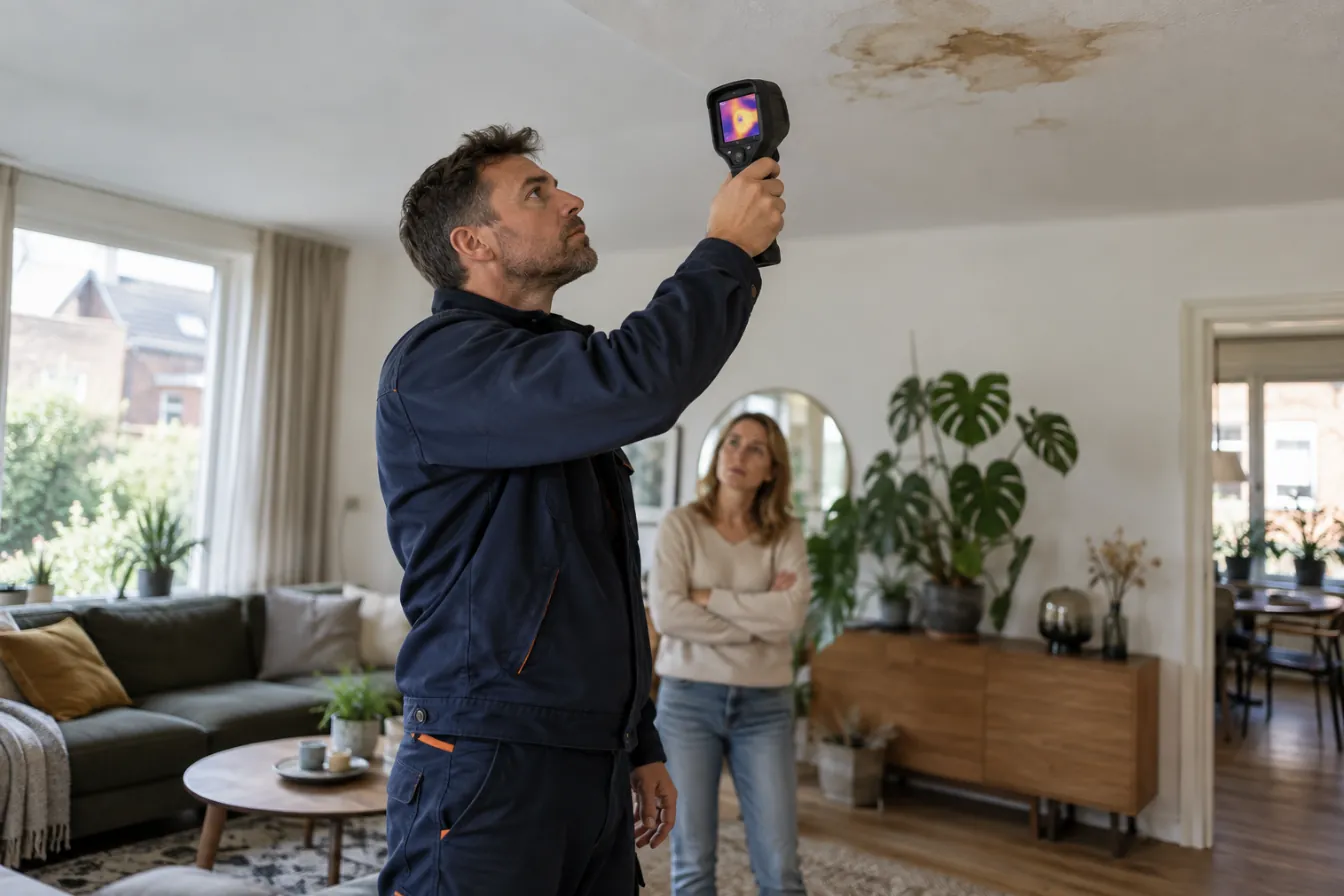
Sound familiar?
These are common warning signs. Not sure? Give us a call for advice.
- Damp patch or water stain on the ceiling
- Flaking paint or peeling wallpaper
- Water meter turning while every tap is off
- Musty smell or mould in an unexpected place
- Rushing sound in the wall when nobody is using water
- Boiler pressure keeps dropping
- Loose tiles or a bulging wooden floor
Our approach
-
Talking it through
On the phone we ask where you're seeing damp, how long it's been there and whether the water meter keeps running. That way the plumber can come prepared, and you get a price estimate up front.
-
Measuring, not breaking
Using a moisture meter, the plumber maps out how far the damp has spread. A thermal camera then reveals hot and cold pipes hidden behind tiles and plaster.
-
Confirming the source
A pressure test on an isolated section of pipe tells the plumber whether that's where the leak is. Only once the source is clear does the plumber make a small, targeted opening.
-
Sealing the leak
A leaking joint, trap or short length of pipe is usually replaced on the spot. We'll explain what caused the leak, so you can pass that on to your insurer or landlord.
Where leaks in the home come from
Water takes the path of least resistance. It can run for metres along a joist or pipe before it shows up anywhere, so the damp patch you see isn't necessarily directly above or next to the leak. That's why leak detection starts with two questions: which pipes run nearby, and what kind of water is it?
Water supply pipes and joints
Many leaks start at a connection: a compression fitting that has vibrated loose, a soldered joint that finally gives out after years, or the connection to a tap behind the washbasin. Older copper pipes can also corrode from the inside, leaving tiny pinholes. Because the water supply is always under pressure, a spot like that leaks day and night, even when nobody is using any water.
Waste pipes, sealant and sanitary ware
A waste pipe isn't under pressure and only leaks when water runs through it. Typical culprits are a cracked strip of sealant along the shower tray, a leaking trap under the washbasin or a loose connection between the toilet and the waste pipe.
Harsh drain cleaners sometimes play a part too. They get hot and attack rubber seals and older pipes, so a drain that was merely blocked ends up leaking as well. That's why we advise against them.
Central heating pipes and underfloor heating
Can you feel a warm, damp spot on the floor, or do you keep having to top up the central heating boiler because the pressure drops? If so, the leak may be in the heating system rather than the water supply. A thermal camera is a useful tool here, because warm pipes light up clearly on the screen.
Signs of a hidden water leak
A leak you can see is usually found quickly. The trickier kind is the one going on behind tiles, inside a floor or above a ceiling. Look out for these signs:
- a ring or damp patch on the ceiling, often below the bathroom or kitchen
- paint that flakes, wallpaper that peels or plaster that feels soft
- mould or a musty smell in a spot that's normally dry
- tiles or skirting boards coming loose, or a wooden floor starting to bulge
- a rushing or hissing sound in the wall when no tap is running
The water meter test
If you're not sure, try this simple test. Turn off all the taps, switch off the washing machine and dishwasher, and wait until the toilet cistern has filled. Note the reading on the water meter in the meter cupboard, don't use any water for an hour, then check it again.
If the reading has changed, or the smallest dial is still turning, water is escaping somewhere. That could be a leaking pipe, but it might also be a toilet that keeps running without you noticing.
First aid: what you can do yourself
If you can see water running or dripping, the first few minutes decide how much damage is done, both in your home and at the neighbours'.
- Turn off the main stopcock. It's usually in the meter cupboard, next to the water meter.
- If water is reaching lights, sockets or appliances, switch off the relevant circuit at the fuse box in the meter cupboard.
- Put down buckets and towels, and move furniture, rugs and electronics out of the way.
- Take photos of the damp patch and the damage.
- Warn the neighbours below or next door and, if you live in a flat, the owners' association (VvE) or the property manager as well.
What to leave alone
Don't start knocking off tiles or poking holes in a ceiling to find the leak yourself. You risk hitting pipes or wiring, and chances are you'll be looking in the wrong place anyway. And keep clear of a ceiling that is sagging or bulging.
If there's no obvious source, if the water meter keeps running while everything is off, or if the water is coming through a ceiling shared with the neighbours upstairs, call us. At that point acting quickly matters more than trying to puzzle it out yourself.
Leak detection: how the plumber finds the source
We carry out leak detection step by step, with measuring equipment rather than a sledgehammer. The aim is to pinpoint the leak as precisely as possible, so that, at most, a small opening is needed.
First, the plumber uses a moisture meter to map how far the damp has spread through the wall, floor or ceiling. The wettest point often tells you more than the visible stain.
A thermal camera then shows the hot and cold pipes behind tiles and plaster; a leaking hot water pipe often shows up as a distinct warm spot. A pressure test involves isolating a section of pipe and pressurising it. If the pressure drops, that confirms the leak is in that section. If a waste pipe is the problem, a drain camera inspection can provide the answer.
From finding the leak to fixing it
Once the source has been found, you'll naturally want the leak fixed as well. The plumber usually replaces a leaking joint, a corroded bit of pipe or a broken trap during the same visit. If a longer section is affected or the leak is under a screed floor, we'll arrange a water pipe repair in consultation with you. If the real cause is a shower that keeps overflowing and pushing water past the sealant, we deal with that too by unblocking the shower drain and resealing the joint.
Limiting the damage: neighbours, owners' association and insurance
A leak rarely affects only your own home. Water runs downwards, so in a walk-up or a block of flats the neighbours below often suffer just as much. Let them know what's going on, even if the leak has already been found. If a shared pipe is involved, such as a soil stack, that's often a matter for the VvE, so report it to the property manager as well.
It helps to give your insurer three things: photos of the damage, when you discovered it, and a description of the cause. You'll get that last one from the plumber. Whether tracing the leak and the repair are covered differs from policy to policy. If you rent, get in touch with your landlord as well.
What leak detection costs, including outside office hours
At Spoed Loodgieter Breeman, simple jobs start from €89. The call-out charge isn't included. Because some leaks are found quickly and others take longer, we first give you a price estimate over the phone, based on your description.
If it's already clear that it's a bigger job, such as a leak in a pipe duct or under a tiled floor, you can ask for a quote. That way you know where you stand before anything starts.
A leak in the middle of the night
Water doesn't keep office hours. A burst washing machine inlet hose or a leak coming through the ceiling on a Sunday night won't wait until Monday. That's why we're available 24/7, including public holidays. Outside office hours we charge an out-of-hours rate, and we'll tell you what it is before anyone sets off.
If the main stopcock is off and the situation is stable, we'll decide together whether a plumber needs to come straight away or whether the next morning will do.
Preventing leaks
Not every leak can be prevented, but many can:
- Once a year, check the sealant around the bath, shower and kitchen worktop, and replace any cracked sealant in good time.
- Every now and then, look in the cupboards under the kitchen sink and washbasin to check that the trap and hoses are dry.
- Turn off the washing machine tap when you go on holiday.
- Drain the outside tap before winter and insulate pipes in unheated spaces.
If a tap is dripping or leaking around its base, replacing or repairing the tap is far less trouble than water damage in your kitchen cupboard.
Leak detection in your area
Tracking down a leak in a canal house in Amsterdam is a different search from finding one in a walk-up flat in The Hague, a 1930s house in Haarlem or a family home in Zoetermeer. Our plumbers know the difference. Our locations page describes how homes were built in many more cities, though we work right across the country.
Suspect a leak? Call 085 115 0249 and have it traced before the damage spreads.
Prices at a glance
Simple jobs start from €89. When you call, you get a price estimate for your situation.
Call-out charge not included.
Questions about leak detection
How do I know if there's really a leak in my water pipes?
Turn off all the taps in the house and switch off the washing machine and dishwasher too. If the water meter is still moving after that, water is escaping somewhere, for example through a leaking pipe or a toilet that keeps running without you noticing. If the meter stands still, the water may be coming from a waste pipe, the central heating, the home above you, or in through the roof or an outside wall.
Does a wall or floor always have to be opened up?
No. Because the plumber measures first, the leak can usually be narrowed down to a small area. It's then often just a matter of removing a single tile or a small patch of plaster to reach the pipe. Sometimes the cause turns out to be a sealant joint or a trap, and nothing needs breaking open at all.
Will my insurance pay for leak detection?
That varies by policy and by insurer. Some buildings insurance policies cover the cost of tracing the leak, and of the opening-up and repair work that goes with it, if there's water damage. If you rent, your landlord may be responsible. Either way, report the damage quickly, take photos and keep the plumber's explanation of the cause.
What should I do if water is coming through the ceiling?
Turn off the main stopcock, and switch off the circuit in the fuse box if the water is near lights or sockets. Put buckets under the drips and move your belongings out of the way. Don't stand under a ceiling that's sagging. Warn the people living above you, as the leak may be in their home, and give us a call.
Can the leak be fixed straight away?
If it's a joint, a short length of pipe, a trap or a strip of sealant, the plumber can often repair it during the same visit. A leak under a screed floor or in a pipe duct sometimes needs more work. In that case we'll put a proposal to you first and you can ask for a quote. Where possible, the leaking section is isolated in the meantime.
Can't find your question? Take a look at our FAQ.
Other services
-
Sewer unblocking
Inspection chamber in the garden full, or water coming up in the shower? To unblock your sewer, the plumber clears the pipe with a drain snake or high-pressure jetting and runs a camera through it if needed.
-
Toilet unblocking
Water rising to the rim when you flush? To unblock your toilet, the plumber starts with a plunger, moves on to a toilet auger if needed and tells you what not to flush in future.
-
Kitchen sink unblocking
Washing-up water not draining? To unblock your kitchen sink, the plumber cleans not just the trap but also the waste pipe in the wall, so the grease doesn't come straight back.
-
Drain unblocking
Washbasin, bath or washing machine waste not draining? To unblock the drain, the plumber clears the trap and plughole, and the soil stack too if needed.
-
Shower drain unblocking
Water left standing in the shower, or a musty smell from the drain? We unblock your shower drain, clear out the hair and soap residue and give you tips to stop it happening again.
-
Water pipe repair
Burst or leaking pipe? Turn off the main stopcock and call us. Our plumber will repair your water pipe, from refitting a joint that has come loose to putting in a new length of pipe.
-
Tap replacement
Dripping, leaking or wobbly tap? Our plumber can replace or repair it, from kitchen taps to thermostatic shower mixers, and will check the isolation valves while they're there.
Need an emergency plumber?
Call now. You get a price estimate straight away and a plumber comes to you as quickly as possible, even at night and at weekends.